Roverpak
A Boy and His DogRoverpak names the decentralized survival groups that organize life after the wars by pooling people, dogs, territory, and useful labor. Their existence turns a devastated landscape into a network of competing local powers: they can provide essential services and limited safety, yet they also surround buildings, enforce claims, and threaten outsiders. For Vic and Blood, roverpaks are the social world they resist, exploit, and repeatedly have to confront.
Formation and Social Function
A roverpak is presented as a collective formed from solos who could not survive by foraging alone. The group therefore represents a compromise between independence and security: individuals surrender some freedom in exchange for comfort, territory, and shared resources. The word carries a canine dimension as well as a human one, since the groups move and operate with their mutts rather than as purely human settlements. This mixed organization makes the roverpak a specifically postwar institution, adapted to a world in which ordinary civic structures have disappeared.
The Metropole Theater is the clearest example of a roverpak converting a scarce cultural resource into political power. Our Gang, a roverpak of movie-oriented youths, took over the territory around the theater. Other groups did not challenge that claim because everyone needed the movies, and Our Gang kept the films running effectively enough to provide a service even to independent survivors such as Vic and Blood. Their authority thus rests less on formal law than on controlled access to something valuable. A territory becomes defensible when its occupants can make themselves useful to the surrounding population.
Territory, Labor, and Unequal Power
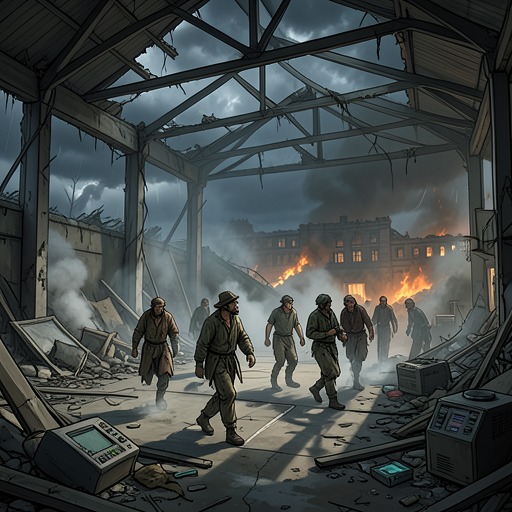
The roverpaks are not organized in identical ways. Their survival strategies reflect the resources available in their territories. The Dragons maintain an entire power plant in order to collect tribute from other roverpaks. Ted’s Bunch supervises the reservoir. The Bastinados work as fieldhands in marijuana gardens. The Barbados Blacks repeatedly lose members while cleaning radiation pits across the city. Our Gang, by contrast, needs only to run a movie house. The contrast exposes a rough political economy in which each group converts control over a place or resource into food, protection, or tribute, while the costs are distributed very unevenly.
This system also explains why the roverpak idea can appear intelligent rather than merely brutal. Whoever first recognized that groups could form from isolated foragers had understood what kinds of services people would pay to preserve. The theater, the power plant, the reservoir, the marijuana gardens, and the radiation pits are different versions of the same principle: territorial organization transforms dangerous work or scarce infrastructure into leverage. Yet the arrangement remains coercive, because access, labor, and safety depend on who controls the territory and on whether outsiders accept the group’s terms.
Sanctuary and the Return of Violence
Roverpaks have also created rules to limit their own violence. A fight at the old Loew’s Granada ended with ten or twelve rovers and their dogs dead, the theater burned, and several valuable Cagney films destroyed. That disaster led the roverpaks to agree that movie houses would function as sanctuaries. The agreement makes cultural preservation and mutual survival inseparable: violence inside a theater threatens not only people and animals but also the films that the groups collectively value.
The sanctuary rule is practical rather than absolute. The Metropole is treated as neutral ground, but someone can still arrive too disturbed or aggressive to soften. The crowded theater contains weapons, guards, tense animals, and the possibility of sudden conflict beneath its public truce. Vic and Blood enter under that arrangement, but the atmosphere remains one of controlled suspicion. The rule demonstrates that roverpaks are capable of collective restraint, while the recurring danger of violation shows how fragile that restraint is.
Conflict with Vic and Blood
Vic and Blood stand outside roverpak membership as solos, but their independence does not free them from roverpak power. At the Metropole, Our Gang’s guards require Vic to surrender his .45 and Browning .22 before admission. He pays for his own ticket with a can of Oscar Mayer Philadelphia Scrapple and Blood’s with sardines, then has to argue with the guard over a leaking pipe that could rust his weapons. The exchange compresses the roverpak’s whole structure into one scene: hospitality is available, but only after payment, inspection, and submission to local authority.
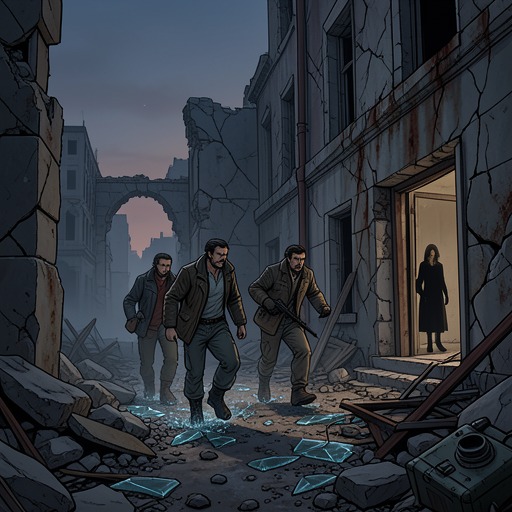
Later, a roverpak surrounds the YMCA while Vic and Blood are inside. Blood detects fifteen or twenty attackers, perhaps more, and Vic faces the tactical uncertainty produced by a collective whose full strength cannot be seen. After Blood kills one attacker by leaping over a rifle and biting through the rover’s throat, Vic shoots the wounded man; they then kill another intruder who rushes through the entrance. Even after three attackers are taken out, they cannot know whether they have faced seventeen, twenty, or twenty-two rovers, whether more will return, or whether hunger and dwindling ammunition will force them into a mistake. The roverpak’s danger lies not only in individual skill but in replaceable numbers, surrounding pressure, and the ability to wait.
Blood’s relation to roverpaks is especially complicated because the groups are connected to the history of his species. The story of Ginger and Ahbhu traces the development of telepathic skirmisher dogs through cetacean experimentation, grafting, selective breeding, and military use during the Third War. Ginger and Ahbhu are identified as Blood’s ancestors. Roverpaks therefore inhabit a world shaped by the same human-animal interdependence that produced Blood’s capacities, even though Vic and Blood resist collective control. The dog who helps a solitary pair survive is descended from animals bred to serve organized warfare.
Breakdown of Partnership and Significance
The roverpak is also invoked when Blood presses Vic to acknowledge his responsibility. Blood reminds him that Vic owes him something and recalls the time a Burnpit-screamer attacked him. He later warns that sharp-tongued solos elsewhere in the city would gladly take Blood as a companion if Vic failed to treat him properly. The threat reveals an alternative social order: Blood is not merely Vic’s possession or weapon, but a valuable and mobile agent who could choose, or be claimed by, another partnership.
Their quarrel exposes the limits of the roverpak model from the opposite direction. Vic promises to do right by Blood as he always has, yet answers the warning with another threat, and Blood stalks away furious. The relationship remains bound by dependence, memory, and mutual danger rather than by a simple hierarchy. Against the organized roverpaks, Vic and Blood form a smaller, more intimate unit: a partnership whose emotional principle is finally condensed in the statement that a boy loves his dog. Roverpak is significant because it supplies the collective background against which that bond becomes visible. It shows what survival looks like when companionship is institutionalized, territorial, and armed—and what is at stake when Vic and Blood try to remain together without becoming part of any larger pack.